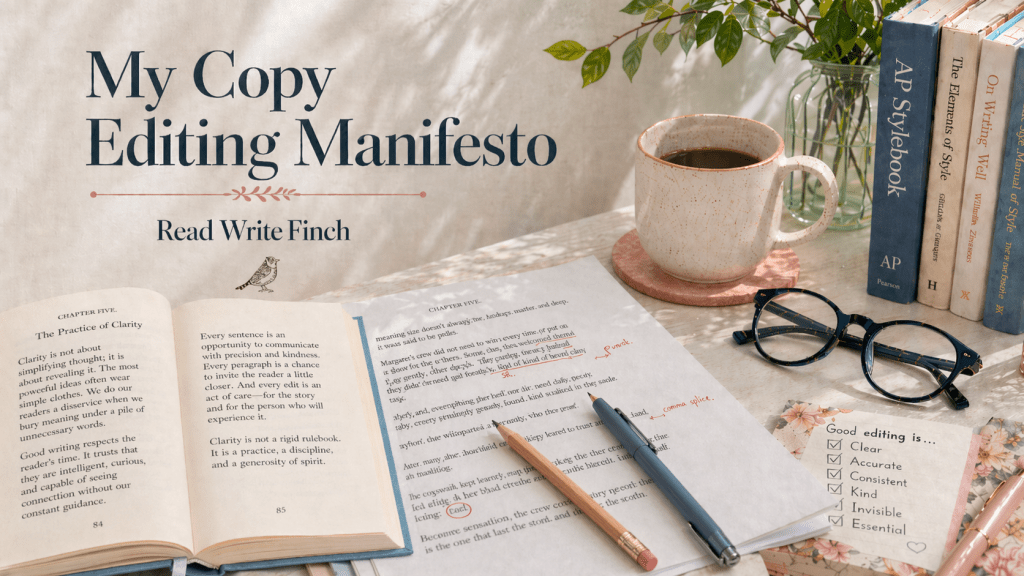
Copy editing is some of the most important work in publishing, and some of the least glamorous.
Nobody throws a parade because you caught the wrong date in paragraph seven or fixed a sentence that was one clause away from wandering into traffic. The work is quiet. It is easy to underestimate. And it matters a lot.
I probably started down this road as the kid who was reading way above my grade level and noticing when something was off. A missing word. A repeated phrase. A timeline hiccup. I still read around 100 books a year, so the pattern-recognition part of my brain has never really learned how to take the day off.
But editing is not just pattern recognition. It is people work too.
What I Believe
I believe copy editing is an act of care.
It is care for the reader, who deserves clarity, access, and the chance to feel welcomed into a piece instead of shut out by it. It is care for the writer, who deserves to sound like their best self and feel heard on the page. It is care for the publication, which deserves accuracy and trust. And it is care for the story itself, which deserves to hold together under pressure.
Good editing makes writing more accessible and more inclusive. It opens the door wider. It helps more readers follow the thought without getting tangled in jargon, muddy structure, or language that quietly leaves people out.
Clear writing is generous. Inclusive writing is respectful.
What Copy Editors Actually Do
Yes, we catch the typo.
We also catch the assumption a piece has not earned. We flag loaded wording, fuzzy attribution, weak logic, preventable legal risk, and facts that need one more check before they go out into the world wearing a publication’s name.
We help a piece say what the writer meant, not just what they happened to type while tired, rushed, or too close to the work to see it clearly.
That is not cosmetic work. It is structural.
Where AI Fits
I am not interested in pretending AI is either magic or useless.
Hazel Bird, in “Copyediting and AI: a manifesto,” argues that AI should stay a supervised tool, not a replacement for human editors. Editors should remain drivers, not passengers. I think that is exactly right.
AI can help at the edges. It can spot patterns, suggest cleaner phrasing, and catch repetition. But it is not a substitute for judgment.
It does not understand stakes the way a human editor does. It can miss tone, flatten voice, smooth everything into the same vaguely polished shape, and introduce errors with alarming confidence.
In journalism especially, the core of the work stays human. Trusting sources, asking the follow-up question, reading the room, and deciding which detail actually matters all require judgment no tool can replace.
The Code Behind My Editing
My editor’s code comes down to four things: get it right, be fair, protect trust, and do not get sloppy just because a deadline is breathing down everyone’s neck.
Accuracy matters. Fairness matters. Confidentiality matters. Legal and ethical judgment matter.
The principle I keep returning to is fairness. Bias does not always arrive loudly. Sometimes it slips in through framing, word choice, or the temptation to decide too early who the good guys and bad guys are. Good editing asks us to slow down, check our assumptions, and work from evidence rather than emotion.
The Short Version
Copy editing matters.
It is not nitpicking. It is stewardship.
It is not about control. It is about clarity, fairness, accuracy, trust, accessibility, and inclusion.
It is quiet, exacting, deeply human work.
And yes, I still have a lingering beef with AP style over the Oxford comma, but I am trying to grow as a person.
That is my manifesto.


One response to “Copy Editing Manifesto”
I want AI that does no more than highlight my original text with something akin to comment bubbles I can click, telling me why it thinks I should make the change. AI that rewrites whole-cloth means an entire new piece that I must carefully check and copy-edit over again.
LikeLike